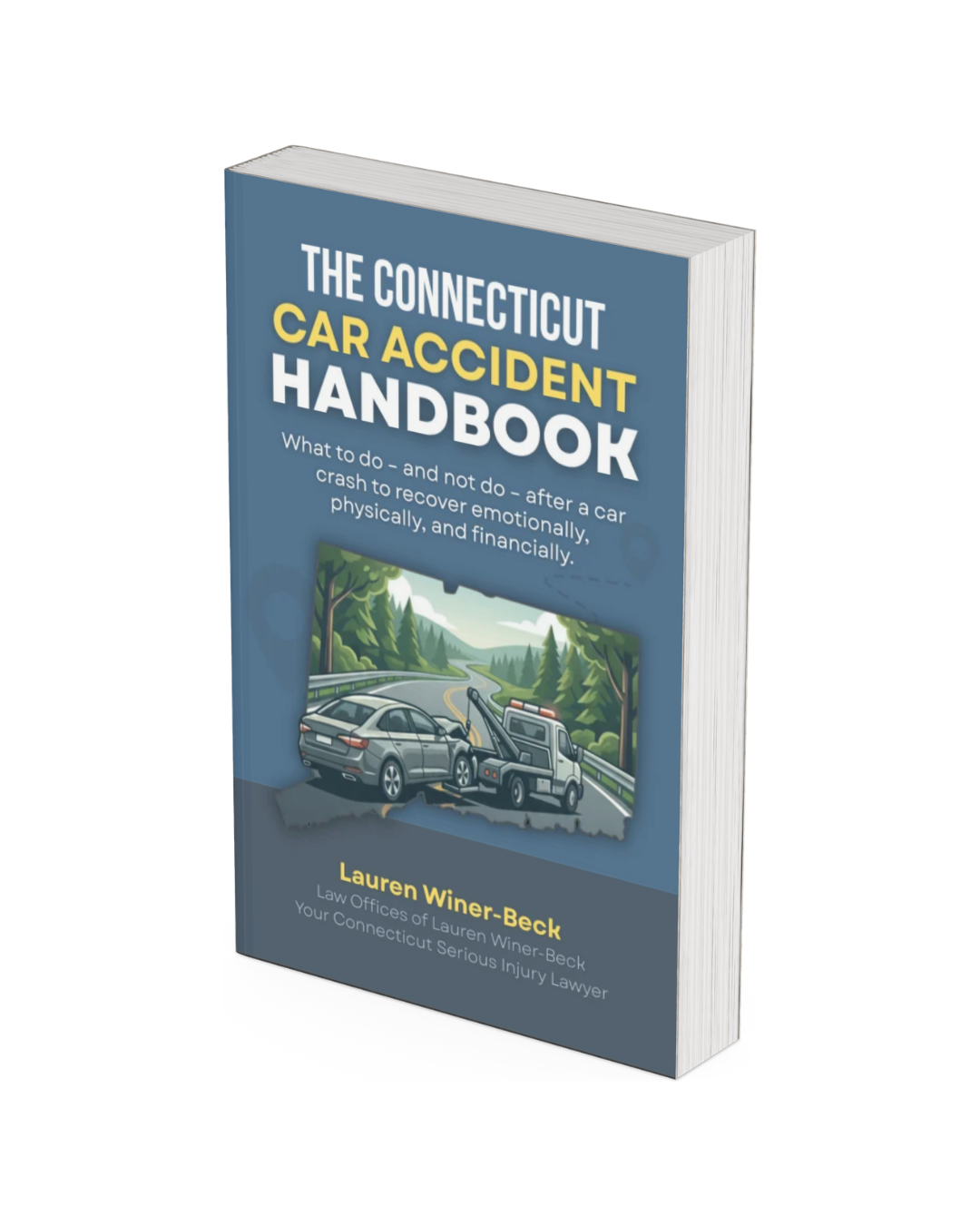
I Wrote the Book on Connecticut Car Accident Claims
If you've been hurt in a crash, this page will help you understand what matters most—and how to avoid mistakes that can hurt your health, your case, and your recovery.
Guidance You Can Trust — From the Attorney Who Wrote the Book
After a car accident, most people don't realize how many small decisions can affect their health, their finances, and their legal rights. Unfortunately, the insurance company is counting on that.
I wrote The Connecticut Car Accident Handbook to give you clear, honest guidance during a confusing time — so you can make informed decisions and avoid mistakes that could hurt your claim.
On this page, you'll find key insights from the book, along with answers to common questions and practical tips to help you protect yourself and move forward with confidence.
Explainer Videos
Short videos explaining what you need to know after a Connecticut car accident.
The First 7 Days After a Car Accident: How to Protect Yourself and Your Claim
The first steps you take after a crash matter more than most people realize. Learn what to do — and what not to do — in the moments right after impact.
Why the Insurance Company Is Not on Your Side
Insurance adjusters are not on your side. Understand how the claims process works — and why you should never give a recorded statement without an attorney.
Frequently Asked Questions
After a car accident, it's normal to have questions—about your injuries, the insurance process, and what to do next. These are the same questions I hear from clients every day. Click any question to read the answer.
What to Do After a Car Accident
What should I do immediately after a car accident in Connecticut?
The moments after a crash can feel chaotic, but the steps you take right away can protect both your health and your legal rights. First, check yourself and others for injuries and call 911 if anyone needs medical attention. Even if injuries seem minor, it's important to involve emergency services so the situation is documented. If it is safe to do so, move vehicles out of traffic to prevent another collision. Then exchange basic information with the other driver, including names, contact information, driver's license numbers, license plate numbers, and insurance details. If you are physically able, gather evidence at the scene. Take photographs of the vehicles, the surrounding roadway, skid marks, traffic signals, weather conditions, and any visible injuries. Try to obtain contact information for witnesses. Finally, seek medical evaluation as soon as possible and report the accident to your insurance company. These steps create a record of what happened and help protect your potential injury claim.
Should I call the police after a car accident, even if it seems minor?
Yes. Calling the police is almost always a smart decision after a car accident. When an officer responds to the scene, they will prepare a police accident report that documents important facts such as the location of the crash, the drivers involved, witness statements, road conditions, and sometimes the officer's observations about fault. This report can become an important piece of evidence if an insurance claim or lawsuit later arises. Even accidents that initially seem minor can lead to injuries that appear hours or days later. An official report helps establish what happened and reduces the chance that the other driver or insurance company will dispute your version of events.
What information should I exchange with the other driver after a crash?
After a crash, limit your conversation with the other driver to exchanging essential information. You should obtain: • The driver's name and contact information • Driver's license number • Vehicle registration information • License plate number • Insurance company and policy number If witnesses are nearby, politely ask for their names and contact information as well. It is also wise to take photographs of the other driver's vehicle and license plate. These details can help prevent confusion later and ensure that the correct parties are identified.
Should I take photos or videos at the accident scene?
Yes. Photographs are often some of the most valuable evidence in a car accident case. If you can safely do so, use your phone to document: • Damage to all vehicles involved • The overall accident scene • Skid marks, debris, or road hazards • Traffic lights or signs near the crash • Weather and road conditions • Visible injuries Photographs can preserve details that may disappear quickly. Vehicles are repaired, skid marks fade, and debris is cleared away. Visual documentation of the scene can help investigators and insurance companies understand exactly what happened.
What should I say—and not say—to the other driver or police?
You should always be polite and cooperative, but you should be careful not to speculate about fault. Provide factual information to the police officer, such as where you were traveling and what you observed before the crash. If you are unsure about something, it is perfectly acceptable to say you are not certain. Avoid statements like: • "It was my fault." • "I didn't see you." • "I'm sorry." While these comments are often said out of politeness or shock, they can later be interpreted as an admission of fault. Determining legal responsibility is a complex process that may involve many factors, and it should not be decided in the immediate aftermath of a crash.
What if the other driver leaves the scene of the accident?
If the other driver leaves the scene, try to remain calm and gather as much information as possible. Write down or photograph: • The vehicle's license plate number • The make, model, and color of the vehicle • The direction the driver traveled after leaving • Any identifying features of the vehicle or driver Call the police immediately and report the hit-and-run. Witnesses and nearby surveillance cameras may also help identify the driver. Even if the driver is never located, you may still have options through your uninsured motorist coverage, which can provide compensation in certain hit-and-run situations.
What if I was too injured to gather evidence at the crash scene?
Your health always comes first. If you are injured, seek medical attention and allow emergency responders to assist you. Fortunately, evidence can often still be gathered later. Police officers typically document the scene and prepare an accident report. Investigators may also review photographs, vehicle damage, surveillance footage, and witness statements. If possible, return to the accident location later or ask someone to photograph the area. Businesses nearby may also have security cameras that captured the crash. An experienced personal injury attorney can help gather and preserve this evidence so your case is not harmed simply because you were too injured to collect it yourself.
Medical Care and Injuries
Should I see a doctor after a car accident even if I feel fine?
Yes. Seeing a doctor as soon as possible after a car accident is one of the most important steps you can take. Many injuries do not cause immediate symptoms. Adrenaline and shock after a crash can temporarily mask pain, making you believe you are unharmed when an injury is actually developing. Prompt medical care protects both your health and your legal rights. A medical evaluation creates an early record connecting your injuries to the accident. If you delay treatment, an insurance company may later argue that your injuries were minor or caused by something other than the crash. Even if you feel fine, it is wise to get checked by a medical professional within a day or two after the collision.
Why do some car accident injuries appear hours or days later?
It is very common for accident injuries to appear hours, days, or even weeks after a crash. During a collision, your body experiences a sudden and often violent force. Immediately afterward, adrenaline and shock can mask pain and other symptoms. As those effects wear off, injuries begin to reveal themselves. Soft tissue injuries such as whiplash, back strain, and ligament damage frequently develop delayed symptoms. Head injuries, including concussions, may also produce symptoms that appear gradually. Because of this delayed onset, it is important to monitor how you feel in the days following a crash and seek medical attention if new symptoms appear.
What are the most common injuries in car accidents?
Car accidents can cause a wide range of injuries, depending on the severity of the collision and how the body moves during impact. Some of the most common injuries include: • Whiplash and other soft tissue injuries • Neck and back injuries • Concussions and traumatic brain injuries • Broken bones • Shoulder and knee injuries • Internal injuries • Emotional trauma such as anxiety or post-traumatic stress Even relatively low-speed crashes can cause significant injuries, particularly to the neck and spine. Because some injuries may not be immediately visible, medical evaluation is essential after any collision involving significant force.
What is whiplash and how serious can it be?
Whiplash is one of the most common injuries in car accidents, particularly in rear-end collisions. It occurs when the head and neck are suddenly forced backward and then forward in a rapid motion, much like the cracking of a whip. This motion can strain or damage muscles, ligaments, and other soft tissues in the neck. While some people recover within weeks, others experience persistent pain, stiffness, headaches, and reduced mobility that can last months or longer. Because whiplash injuries do not always appear on X-rays or other imaging tests, they are sometimes underestimated by insurance companies. However, the pain and limitations caused by these injuries can be very real and very disruptive to daily life.
Can a car accident cause a concussion or traumatic brain injury even if I did not hit my head?
Yes. A traumatic brain injury can occur even if your head never strikes anything during the crash. When a vehicle stops suddenly, the brain can move inside the skull due to the rapid motion of the head and neck. This movement can disrupt brain function and cause a concussion or other type of traumatic brain injury. Symptoms of a concussion may include: • Headaches • Dizziness • Memory problems • Difficulty concentrating • Fatigue • Mood changes • Sensitivity to light or noise Because brain injuries can be difficult to detect and symptoms may develop gradually, it is important to seek medical attention if you experience any of these signs after a collision.
What if the emergency room says I'm okay but I still have pain later?
This happens more often than people realize. Emergency rooms focus primarily on identifying life-threatening injuries such as internal bleeding or fractures. If these conditions are ruled out, you may be discharged even though soft tissue injuries or concussions are still developing. If pain, stiffness, headaches, or other symptoms appear after your ER visit, you should follow up with your primary care doctor or a specialist as soon as possible. Continuing medical care allows doctors to diagnose injuries that were not immediately visible and helps ensure that you receive appropriate treatment.
What if I don't have health insurance after a car accident?
Many people worry about medical bills after a crash, especially if they do not have health insurance. The most important thing is not to delay treatment because of financial concerns. Your health should always come first. There may be several ways to obtain treatment after an accident: • Medical providers who treat patients with injury claims • Payment arrangements or liens that are resolved after the case settles • Coverage under certain insurance policies • Other sources of financial assistance An experienced personal injury attorney can often help coordinate medical care and explain your options so that you can receive treatment while your claim is being pursued.
Insurance Claims and Adjusters
Should I report the accident to my insurance company?
Yes. Most auto insurance policies require you to report an accident promptly, even if the other driver appears to be at fault. When you notify your insurance company, stick to the basic facts: when and where the accident occurred and the vehicles involved. Avoid speculating about fault or the extent of your injuries, especially if you are still being evaluated by doctors. Reporting the accident protects your ability to access benefits under your own policy if they become necessary—for example, if the other driver turns out to be uninsured or underinsured.
Do I have to speak with the other driver's insurance adjuster?
You are not required to speak with the other driver's insurance company right away. Insurance adjusters often contact accident victims soon after a crash. While they may sound friendly and helpful, it is important to remember that the adjuster works for the insurance company—not for you. Their job is to gather information and resolve claims as quickly and inexpensively as possible. You can politely decline to discuss the accident until you have had time to seek medical care and consider your options. Many people choose to consult with a personal injury attorney before speaking with the other driver's insurer.
Should I give a recorded statement to an insurance company?
In most cases, you should be cautious about giving a recorded statement to the other driver's insurance company. Adjusters often request recorded statements early in the claims process. They may describe it as a routine step or say they just want to "get your side of the story." However, the purpose of a recorded statement is often to capture comments that could later be used to question your claim. Even small inconsistencies or innocent remarks can be taken out of context. For this reason, many attorneys advise clients not to provide recorded statements to the opposing insurance company without legal guidance.
Why does the insurance company want access to my medical records?
Insurance companies often ask accident victims to sign medical authorizations that allow them to review medical records. While some medical information may be relevant to your claim, insurance companies sometimes request broad or "blanket" authorizations that give them access to years of unrelated medical history. The reason is simple: they are looking for anything they can use to argue that your injuries existed before the accident or were caused by something else. Because medical privacy is important and these requests can be very broad, it is wise to review any authorization carefully before signing it—or ask your personal injury attorney to review it.
Why do insurance companies make quick settlement offers after an accident?
Quick settlement offers are common after car accidents, especially when injuries are not yet fully understood. At first glance, an early offer may seem appealing. You may be dealing with medical bills, missed work, and the stress of recovery. However, early offers are often made before the full extent of your injuries is known. Once you accept a settlement, you typically must sign a release giving up the right to seek additional compensation—even if your condition worsens later. For this reason, it is important to understand your medical situation and the long-term impact of your injuries before agreeing to settle your claim.
What happens if the driver who hit me doesn't have insurance?
Unfortunately, accidents involving uninsured drivers happen more often than people realize. If the at-fault driver has no insurance—or not enough insurance to cover your damages—you may still have options through your own uninsured or underinsured motorist coverage. This coverage is designed to protect you in situations where the responsible driver cannot fully compensate you for your injuries. Although you are making a claim through your own insurance policy, the process can still involve negotiations similar to any other injury claim. Understanding your policy and your rights can make a significant difference in the outcome.
Fault and Liability in Connecticut
How is fault determined in a Connecticut car accident case?
In most car accident cases, determining fault comes down to whether a driver acted negligently. Negligence means failing to act with the level of care that a reasonably careful driver would use under similar circumstances. To establish negligence, four basic elements must be proven: • The driver owed a duty of care to others on the road • The driver breached that duty by acting carelessly or violating traffic laws • The driver's conduct caused the accident • The accident caused injuries and damages Evidence such as police reports, witness statements, photographs, vehicle damage, and traffic laws are often used to determine which driver was responsible for the crash. In some cases, more than one driver may share responsibility.
Can I still recover compensation if I was partially at fault for the accident?
Yes. Connecticut follows a legal rule called modified comparative negligence. Under this rule, you may still recover compensation for your injuries as long as you were not more than 50% responsible for the accident. However, your compensation will be reduced by your percentage of fault. For example: • If your damages total $100,000 • And you are found to be 20% responsible • Your recovery would be reduced by 20%, meaning you could receive $80,000 If you are found to be more than 50% responsible, you cannot recover compensation from the other party.
What evidence helps prove who caused a car accident?
Several types of evidence can help establish liability in a car accident case: • Police accident reports • Photographs of the vehicles and accident scene • Witness statements • Traffic camera or surveillance footage • Vehicle damage patterns • Medical records documenting injuries • Expert analysis of how the crash occurred Sometimes physical evidence from the scene—such as skid marks, debris patterns, or vehicle positions—can help investigators determine how the accident happened. The stronger the evidence showing that another driver violated traffic laws or drove carelessly, the stronger the case for liability.
What if the police report is wrong?
Police accident reports are important documents, but they are not always final or unquestionable. Officers typically arrive after the crash has already occurred, so they must rely on statements from drivers and witnesses, along with their observations of the scene. If a police report contains errors—such as incorrect details about how the crash occurred or who was involved—it may be possible to correct or challenge those findings. Other evidence can sometimes outweigh a police report, including photographs, witness testimony, surveillance footage, or expert accident reconstruction. If the accuracy of the report becomes an issue, your attorney can investigate the circumstances and present additional evidence to clarify what happened.
What if there were no witnesses to the accident?
A lack of witnesses does not necessarily prevent you from pursuing a claim. Many car accident cases are proven through other types of evidence. Physical evidence from the scene, vehicle damage patterns, and electronic data from vehicles can help reconstruct how the crash occurred. Police reports, photographs, and expert analysis may also play an important role in determining fault. Even when two drivers tell conflicting stories, investigators can often piece together what likely happened based on the available evidence.
Compensation and Claim Value
What compensation can I recover after a car accident?
If you were injured because another driver was negligent, you may be entitled to recover compensation—called damages—for the losses you suffered. Depending on the circumstances of your case, damages may include: • Medical expenses (past and future) • Lost wages from missed work • Loss of future earning capacity • Property damage to your vehicle • Out-of-pocket expenses related to your injuries • Physical pain and suffering • Emotional distress and reduced quality of life The goal of a personal injury claim is to restore you, as much as possible, to the financial position you would have been in if the accident had never occurred.
How is the value of a car accident claim determined?
The value of an injury claim depends on many factors, and no two cases are exactly alike. Some of the most important factors include: • The severity of your injuries • The amount of medical treatment required • The impact on your ability to work • The clarity of the other driver's fault • The quality of your medical documentation • The long-term effects of your injuries Insurance companies carefully evaluate these factors when determining settlement offers. Strong medical evidence, consistent treatment, and clear proof of liability generally increase the value of a claim. Because every case is unique, an experienced attorney can help assess the potential value of your claim once the facts and medical evidence are fully understood.
What is "pain and suffering" in a personal injury case?
"Pain and suffering" refers to the physical discomfort and emotional distress caused by an injury. Unlike medical bills or lost wages, these damages do not have a simple dollar amount attached to them. They reflect how the injury has affected your daily life. Pain and suffering damages may include: • Physical pain and ongoing discomfort • Emotional distress, anxiety, or depression • Loss of enjoyment of activities you once enjoyed • Limitations on daily activities • Long-term physical impairment Medical records, photographs, treatment notes, and testimony from family members or coworkers can help demonstrate how the injury has affected your life.
What factors can reduce the value of my injury claim?
Several issues can affect the value of a personal injury case: • Delays in seeking medical treatment • Gaps or inconsistencies in medical care • Limited medical documentation • Evidence that the injured person was partially at fault • Pre-existing injuries involving the same body parts Insurance companies often look closely at medical records and treatment history when evaluating a claim. Clear documentation and consistent medical care can strengthen your case and reduce disputes over the seriousness of your injuries.
How long does it usually take to settle a car accident case?
The timeline for resolving a car accident case varies depending on several factors. Some cases involving minor injuries may settle within a few months. Others may take longer if: • Medical treatment is ongoing • Liability is disputed • Multiple insurance companies are involved • The case proceeds to litigation In general, it is usually best not to settle a case until your doctors understand the full extent of your injuries and your future medical needs. Settling too early can leave you responsible for medical costs that arise later.
Hiring a Connecticut Car Accident Lawyer
Do I need a lawyer for a car accident claim?
Not every accident requires a lawyer. However, legal guidance can be very helpful when injuries are serious or when insurance companies dispute the claim. An experienced personal injury attorney can: • Investigate the accident • Gather evidence and medical documentation • Communicate with insurance companies • Evaluate settlement offers • Represent you if a lawsuit becomes necessary Having someone who understands the legal process can help ensure that your rights are protected and that important deadlines and procedures are handled properly.
When should I contact a Connecticut personal injury lawyer?
If you were injured in a car accident, it is usually a good idea to consult an attorney sooner rather than later. Early legal guidance can help protect important evidence, clarify insurance issues, and prevent mistakes that could harm your claim. Situations where contacting a lawyer early is especially important include: • Serious or long-term injuries • Disputes about fault • Significant medical bills or lost income • Pressure from insurance companies to settle quickly Most personal injury lawyers offer free consultations, so speaking with one can help you better understand your options.
How much does it cost to hire a car accident lawyer?
Most Connecticut personal injury attorneys work on a contingency fee basis. This means you typically do not pay attorney's fees up front. Instead, the lawyer receives a percentage of the recovery if the case is successfully resolved through a settlement or court judgment. If there is no recovery, attorney's fees are generally not owed. This arrangement allows injured people to pursue their legal rights without having to pay legal fees while they are already dealing with medical bills and other financial challenges after an accident.
From the Book
Inside The Connecticut Car Accident Handbook
I wrote this book to guide you step by step through what happens after a car accident—what to do, what to avoid, and how to protect yourself along the way. Below is a look inside.
After the Wreck, Be Careful What You Say and Do§1:08 Avoid Admitting Fault
Here in Connecticut, we're raised to be polite. But after a crash, those good manners can come back to bite you. It's second nature for people to say, "I'm sorry" or "This was my fault," without even realizing it. We get it. You're shaken up and trying to be decent. But let me be really clear: Those words can seriously damage your case. Insurance companies jump on statements like, "I didn't see you" or "I shouldn't have been in such a hurry," and twist them into full-blown admissions of fault, even when that's not what you meant. So here's the rule: Be human, be kind, but don't assign blame. You can check on the other driver, ask if everyone's okay, and wait for help, but don't talk about who caused the crash. That's not your job. Let the professionals – police, attorneys, and investigators – sort it out.
§1:09 Don't Say "I'm Fine" — The Dangers of Downplaying Injuries
Your body's first reaction to trauma is adrenaline. You might feel shaky or rattled, but not necessarily in pain. That doesn't mean you're uninjured. It means your body is still in fight-or-flight mode. Too many people tell the officer or the other driver, "I'm fine," just to avoid being a bother or because they're embarrassed, or because they honestly don't feel anything yet. Then, the next day or even hours later, the pain hits. And guess what? The insurance adjuster will quote your own words back to you: "Well, you said you were fine." Don't lie, but don't minimize. If something hurts, say so. If you're not sure, say you're not sure. "I'm shaken up and not sure yet" is a perfectly reasonable response. It keeps the door open and protects you if your symptoms take time to appear, as they often do.
§1:10 Do Not Discuss the Accident with the Other Driver Beyond the Basics
When it comes to talking to the other driver, less is more. If you've called the police, let the responding officer get the other driver's name, contact information, and insurance details. If you want to gather this information yourself, that's fine, but don't do more than that. Don't talk about what you think happened. Don't apologize. Don't speculate. And absolutely don't engage in a debate or let them record you. Even if they seem nice, this is not the time to have a heart-to-heart. People change their stories. It happens all the time. And if they've got a recording or memory of you saying something they can twist to support their version of events, you've just handed them a weapon they can use against you. Keep it calm. Keep it civil. Keep it brief.
§1:11 Stay Off Social Media
This might feel like a minor thing, but it's not. One social media post can do real damage to your case. We tell all our clients: Do not post about the crash. Don't post photos of the scene, don't comment on what happened, and don't share updates about your recovery – not even a harmless "Thank goodness everyone's okay." Insurance companies and defense lawyers will absolutely check your accounts. They'll take screenshots, twist your words, and argue that you're exaggerating. That one grateful post you made could be used to say your injuries aren't serious, even if you're in agony days later. Play it safe. Go dark on social media – at least until your case is resolved.
Tips for Handling Your Medical Care§2:11 Be Honest with Your Medical Providers
This isn't the time to be tough or downplay your pain. Be completely honest with your doctors about how you're feeling. Tell them what hurts, how often, how bad it is, and how it's impacting your life. If you don't mention a symptom, it might not get documented. If it's not in your medical records then, as far as the insurance company is concerned, it never happened. Worse, if your story changes later, they'll accuse you of exaggerating or even lying. So be thorough. Be specific. Be truthful. Your medical records are the foundation of your case, and your credibility is one of your greatest assets.
§2:12 Keep Your Appointments and Follow Your Doctor's Treatment Plan
Insurance adjusters are trained to look for gaps in your care. If you start missing appointments, cancel follow-ups, or disappear for weeks, they'll argue that your injuries must not be serious or that you stopped needing treatment. Life happens. We get it. Maybe you have kids to juggle, work obligations, or transportation issues. If you have to miss an appointment, reschedule it promptly. If something about the treatment isn't working for you – say, it's too intense, too expensive, not helping – talk to your doctor. Don't just stop going. A consistent, documented pattern of care tells the insurance company: "This person is taking their recovery seriously."
§2:13 Don't Stop Treating Until You're Officially Released
You might feel "good enough" to stop treatment, but that doesn't mean it's time to stop. Let your doctor make that call. If you quit too soon, the insurance company will use it against you. They'll claim any lingering symptoms aren't from the crash or that you made things worse by not finishing your treatment. On the flip side, if your doctor officially documents that you've reached maximum medical improvement (MMI), that carries real weight in your claim. So, keep going until your provider says you're done.
§2:14 Consider Mental Health Care
Not all injuries are physical. A car crash can leave deep emotional scars, too. If you're feeling nervous, or if you're always on edge or worried, or if you're having trouble driving again or sleeping, talk to your doctor. You might be experiencing PTSD, anxiety, or depression. These are real injuries that deserve real care, just like a broken bone or a concussion. Getting mental health support not only helps you heal, it also strengthens your claim by showing the full impact the crash has had on your life.
§2:15 Document Everything
Every appointment, every prescription, every bill – it all matters. Your official medical records show the trajectory of your injuries and treatment, but it's a good idea to keep your own copies too. Save: • Doctor visit summaries • Prescriptions and medication instructions • Medical bills • Insurance statements • Receipts for co-pays, over-the-counter supplies, or transportation • Emails or texts with your providers Keeping this information organized gives your attorney the tools they need to build the strongest case possible and protects you in case anything gets lost or overlooked.
Master the "Paper Trail" Principle§3:14 Why Everything Should Be in Writing
If there's one truth in every personal injury case, it's this: If it's not written down, it didn't happen. That might sound harsh, but it's how insurance companies operate. They don't care what someone said on the phone or promised in passing. They want documentation. So do we. Here's what you should aim to put in writing: • Details of any conversation with an insurance adjuster • Requests or denials for medical treatment • Time missed from work • Symptoms or setbacks • Questions for your doctor (and their responses) • Confirmations of appointments or rescheduled visits If someone says something important over the phone — like an adjuster promising to "get back to you soon with an offer" — follow up with an email or note. It doesn't need to be fancy. Just a quick, "Hi, just confirming our conversation today where you said..." is enough. You're building a record. That paper trail can become your best protection if someone tries to backpedal later. Be Claim-Smart: Insurance companies love to pretend a promise was never made. A quick email or text confirming the communication can change everything. If it's important, get it in writing or put it in writing yourself.
§3:16–3:17 Create a Claim File — What to Include
Personal injury cases aren't won on memory. They're won on proof. A paper trail makes your story harder to dispute and easier to believe. Use a binder with labeled tabs or create digital folders on your computer or phone. Your claim file might include separate folders for: • Medical records • Medical bills and receipts • Lost income documentation • Police report and accident photos • Pain journal and symptom logs • Communication with your insurance company • Communication with the other driver's insurance company Think of it as your personal injury command center. Include: • Accident documents: Police report, crash photos, witness information • Medical treatment: Visit summaries, diagnoses, prescriptions, therapy referrals • Billing records: Statements from providers, receipts, insurance EOBs • Time off work: Pay stubs, notes from your employer, disability paperwork • Out-of-pocket expenses: Rideshare receipts, childcare, medical devices, co-pays Be Claim-Smart: It's easy to overlook a $10 co-pay here or a $35 Uber ride there. But over time, these small costs add up, and they're recoverable if we can prove them. Take a photo of every receipt and store it in a dedicated folder on your phone.
Understanding Damages in a Personal Injury Claim§4:01 Types of Compensation You Can Recover
"Damages" is a legal term that means (1) the harm you have suffered as a result of the injury-accident; and (2) the compensation you are entitled to as a result of that harm. The law divides damages into two big categories: Economic damages – These are the financial losses that can be measured and proven with bills, receipts, and pay stubs. They include: • Past and future medical expenses • Lost wages • Loss of future earning capacity • Prescription costs, transportation to appointments, household help, and other out-of-pocket expenses Non-economic damages – These are harder to measure, but just as real. They include: • Pain and suffering • Emotional distress • Mental anguish • Loss of enjoyment of life • Disruption to your relationships and activities You are entitled to be compensated for all of these losses – not just your ER bill or lost time from work. A big part of what we do is making sure the insurance company understands the full impact this crash has had on your life, beyond what shows up in your medical records.
§4:03–4:04 The Role of Insurance in Valuing a Claim
It's important to understand that insurance companies aren't motivated by fairness. They're motivated by money — more specifically, by how much money they can keep in their pockets and how little they can pay you. Sometimes, no matter how strong your case is, your recovery is limited by the size of the available insurance policy. In Connecticut, the state minimum for liability coverage is just $25,000 per person. If the at-fault driver only carries the minimum, that may be all that's available, unless you have underinsured motorist (UIM) coverage. Here's how it works: • If your claim is worth $100,000, but the other driver only has $25,000 in coverage, you may be limited to that amount unless you have UIM. • If your UIM coverage is $100,000, we may be able to recover the additional $75,000 from your own policy. This is why it's so important to review your auto policy now, before a crash happens. Be Claim-Smart: Don't guess what your case is worth based on someone else's. Every case is different. Value depends on treatment, documentation, liability, and many other factors. Keep track of ALL out-of-pocket expenses — co-pays, crutches, braces, Uber rides to physical therapy. These add up and can be included in your settlement demand.
Understand Who the Adjuster Really Works For§6:01 The Adjuster Is Not Your Advocate
After a crash, it's common for people to assume the insurance company will treat them fairly — especially if the accident wasn't their fault. That assumption is understandable. You've paid premiums. You've followed the rules. You're injured. Surely, they'll do the right thing. But insurance companies are not charities, and adjusters are not advocates. An adjuster's role is to evaluate claims in a way that minimizes what the company pays out, not maximizes what you receive. That doesn't mean every adjuster is rude or dishonest. Many are polite, professional, even sympathetic. But sympathy doesn't change the math. Every dollar they shave off your settlement is a win for the insurance company. That's why it's dangerous to treat adjusters like advisers or allies. When you do, you tend to talk too much, explain too much, and share information that can later be used to reduce or deny your claim.
§6:03–6:04 Why "Just Being Honest" Isn't Enough — The Friendly Voice Trap
We hear this all the time: "I'm just telling the truth. I'm not trying to hide anything." Honesty is important, but unguarded honesty – speaking without understanding how your words may be interpreted – can be costly. Insurance adjusters don't listen the way your doctor or your friend does. They listen for inconsistencies, for gaps, and for statements that can be taken out of context. For example: • Saying "I'm feeling better" may be used to argue you've fully recovered. • Saying "I had some back pain years ago" may be used to deny current treatment. • Saying "I didn't think it was that bad at first" may be used to challenge your injuries. One of the most effective tools adjusters use is friendliness. They'll ask how you're doing, sympathize with your situation, and say things like "I just want to help you" or "We want to take care of this for you." The conversation may feel casual. You might relax. You might vent. You might fill silences with extra details. That's when mistakes happen. These conversations are not casual. They are business communications. Notes are being taken. Statements are being logged. Sometimes calls are recorded. Be Claim-Smart: Never forget who the adjuster works for. Every conversation with an insurance adjuster should be treated as part of your claim record. If you wouldn't want a statement read back to you later, don't say it.
Why Insurance Companies Love Unrepresented Claimants§7:01–7:04 What "Unrepresented" Really Means to an Adjuster
When an adjuster sees that you don't have a lawyer, it immediately changes how they evaluate your claim. "Unrepresented" means the insurance company knows: • You may not know the full value of your claim. • You may not understand the long-term impact of your injuries. • You may not recognize negotiation tactics when they're used. That knowledge gives them leverage. When there is no lawyer involved, the adjuster controls the pace of the claim, the flow of information, how your injuries are framed, and when and how settlement discussions happen. One of the hardest things for people to accept is this: Claims without lawyers often settle for less — sometimes significantly less — than when a lawyer is on board. That happens because future medical needs aren't fully accounted for, pain and suffering are undervalued or ignored, lost income isn't properly documented, and pressure leads to early, lowball settlements. Be Claim-Smart: Insurance companies don't fear fairness; they fear leverage. When you're unrepresented, the adjuster holds most of the cards. Legal representation doesn't guarantee a specific result, but it does change the balance of power. That alone can make a meaningful difference.
§7:13–7:16 What a Personal Injury Lawyer Actually Does for You
One of the first and most immediate benefits of hiring a lawyer is this: you stop having to talk to the insurance company. Once a lawyer is involved: • Adjusters are required to communicate through counsel. • Recorded statements and casual questioning stop. • Pressure tactics lose their effectiveness. This alone brings enormous relief to many clients. It allows you to focus on healing, not on saying the "right" thing or worrying about being misquoted. A lawyer's job is to make sure nothing important is missed or undervalued. That includes collecting and organizing medical records and bills, documenting lost income and future earnings impact, gathering supporting evidence, and making sure treatment and symptoms are accurately reflected. Insurance companies also negotiate differently when a lawyer is involved. A lawyer understands how claims are valued, knows when an offer is unreasonable, can present evidence effectively, and is prepared to escalate if necessary. Be Claim-Smart: A lawyer's job isn't to take over your story; it's to protect it. You still make the decisions. A good lawyer provides guidance, handles the pressure, and makes sure your claim is evaluated based on the full impact of the accident — not just what's easiest for the insurance company to see.
From the Author
Why I Wrote The Connecticut Car Accident Handbook
Most people never expect to need a car accident lawyer.
Then one day, they're sitting on the side of the road after a crash—shaken, injured, and unsure what to do next. Within hours, the phone starts ringing. Insurance adjusters want statements. Medical providers ask about coverage. Bills start arriving before there's even time to process what happened.
In that moment, people are expected to make important decisions about their health, their finances, and their legal rights—often without good information.
Over the years, I've seen how easy it is for accident victims to make mistakes during those early days and weeks after a crash. They delay medical care because they think they're "probably fine." They give recorded statements to insurance companies without realizing how their words might be used later. Or they accept a quick settlement offer before they understand the true extent of their injuries.
Once those mistakes happen, they can be very difficult to undo.
That's why I wrote The Connecticut Car Accident Handbook.
I wanted to give injured people a clear, straightforward guide to what actually happens after a crash—and what they can do to protect themselves physically, emotionally, and financially. The book explains the accident claim process in plain English and shares practical steps you can take to avoid the most common pitfalls.
It's not written for lawyers.
It's written for people who are going through one of the most stressful experiences of their lives.
My goal is simple: to help you understand your rights, make informed decisions, and avoid costly mistakes while you focus on healing and moving forward.
Who This Book Is For
You don't have to be seriously hurt to benefit from this book. Whether you walked away from a fender-bender or are facing a long road to recovery, understanding the claims process can protect you, your health, and your financial future.
This book is for you if:
✓
You were recently injured in a Connecticut car accident
You're in the middle of it right now — dealing with injuries, insurance calls, and uncertainty. This book will walk you through exactly what to do next.
✓
You're not sure whether you have a case
Maybe the accident seemed minor, or you're not sure if your injuries are "serious enough." This book explains what actually matters when evaluating a claim — and why your instincts about what qualifies might be wrong.
✓
The insurance company has already contacted you
Adjusters move fast for a reason. Before you say anything or sign anything, read this book. You'll understand exactly what they're looking for — and how to protect yourself.
✓
You're worried about medical bills and lost income
Injuries affect more than your body. This book covers what types of compensation may be available and how to document your losses so nothing is left on the table.
✓
A family member was hurt in a crash
When someone you love is injured, you want to help — but you might not know how. This book gives you the knowledge to support them through the process and make sure the right steps are taken.
✓
You want to be prepared before anything happens
The best time to learn about this process is before you need it. Understanding your rights in advance means you won't be caught off guard if the unexpected ever occurs.
You don't need a law degree to protect yourself after a car accident. You just need the right information at the right time.
What You'll Learn
After a car accident, most people have the same questions:
What should I do right now?
Should I talk to the insurance company?
How do I prove my injuries?
And what is my case actually worth?
The Connecticut Car Accident Handbook was written to answer those questions—and many others—in clear, practical language. Inside the book, you'll learn:
1
What to do in the first 24 hours after a crash.
The actions you take immediately after an accident can affect both your recovery and your legal rights. The book explains the most important steps to take—and the mistakes to avoid—during those first critical hours.
Chapter 1: Right After the Wreck — What to Do in the First 24 Hours
2
Why medical care matters—even if you think you're fine.
Many accident injuries do not appear right away. You'll learn how delayed symptoms occur, why prompt treatment is important, and how medical records often become the foundation of an injury claim.
Chapter 2: See a Doctor, Even If You Feel "Fine"
3
How to build a strong injury claim.
From photographs and witness statements to medical documentation and injury journals, the book explains how evidence is gathered and used to support your case.
Chapter 3: Build a Strong Claim
4
How insurance companies evaluate accident claims.
Insurance companies investigate every claim carefully. The book explains how adjusters approach cases, what information they look for, and how certain mistakes can weaken a claim.
Chapter 4: How Much Is Your Claim Worth?
5
What determines the value of a car accident case.
No two cases are exactly alike. You'll learn about the factors that influence compensation, including medical evidence, liability, and the long-term impact of injuries.
Chapter 5: Key Issues of Proof in Specific Car Accident Scenarios
6
Common accident scenarios and the issues that arise in each.
Rear-end crashes, intersection collisions, pedestrian accidents, and truck crashes can involve different legal and evidentiary challenges. The book explains the key issues that often arise in each situation.
Chapter 6: Dealing with the Adjuster — Communication Do's and Don'ts
7
When it may be time to consult a lawyer.
Many accident claims can be resolved without major legal complications. Others involve disputes over liability, serious injuries, or aggressive insurance tactics. The book explains when legal guidance may be helpful and what to expect if a claim becomes more complex.
Chapter 7: When It's Time to Call a Lawyer
Experienced Guidance You Can Rely On
Lauren Winer-Beck
Connecticut Personal Injury Attorney
I've spent decades working in personal injury law—first as a paralegal, and now as an attorney representing injured clients across Connecticut. Over the years, I've handled hundreds of accident cases and seen firsthand how overwhelming the process can be.
That experience is why I focus on more than just the legal side of your case. I take the time to understand what you're going through, explain your options clearly, and guide you through each step so you feel informed, supported, and protected.
If you'd like to talk about your situation, I'm here to answer your questions and help you understand your options.
20+ Years of Experience
Connecticut personal injury law
Multiple Award Winner
Connecticut Trial Lawyers Association member
Hundreds of Clients Served
Across Fairfield County and beyond
What Clients Say About Us
★★★★★4.8 · 47 Google Reviews
★★★★★
"My mom got injured after she got hit by a car and we initially went to a local big attorney who took the case but wouldn't even call us back and later dropped the case. We went to Attorney, Lauren Winer-Beck and got the best service and the best experience we have ever had with a Law firm. The Becks treated us like family and stayed in constant communication with us from day one! Attorney, Lauren Winer-Beck got us a great settlement, when other law firms gave us the run around! We cannot thank this great team enough! If you need an attorney, go with the Becks, their gonna take care of you!!"
Beau Kline
★★★★★
"Lauren and Jeff were so friendly and helpful from the very beginning. They got me treatment for my injuries, checked in with me frequently and even drove to my house for meetings to make life easier on me. They both have gone above and beyond, and I would definitely recommend their practice. What a great team they make!!"
Jessica Capra
★★★★★
"A family member referred me to Attorney Winer-Beck after being the victim of a motor vehicle accident by an uninsured vehicle. I am very thankful for having Attorney Winer-Beck by my side from start to finish. Attorney Winer-Beck did not give up on my settlement until it completely worked for me. I highly recommend Attorney Winer-Beck to anyone dealing with an injury claim. They are the best at what they do!"
Darwin Delgado
Need Help with a Connecticut Car Crash or Other Serious Personal Injury Matter?
Get a Free Copy of Lauren Winer-Beck's Book or Schedule a Confidential, No-Obligation Case Review.
Download your free copy or speak directly with Attorney Lauren Winer-Beck — no pressure, no obligation.
Thank you for considering our law firm for your legal needs. We are pleased to provide you this absolutely free and confidential consultation.
Simply complete and submit the below form, and Attorney Winer Beck will review your information, and respond to your inquiry. If you wish to speak with Attorney Winer Beck please call today at 203 542 5240.
CALL BACK GUARANTEE - if I'm your lawyer, all you have to do is call my office one time and we will get back to right away.